
Greece · Ionian Islands
Zakynthos, beyond the cliff-top photo
Everyone comes for one view of one beach. The island that surrounds it — turtle bays, Venetian ruins, a town rebuilt twice over — is where the week actually happens.
The island that gave Greece its national anthem and kept the rest of itself quiet · 37.79° N · 20.90° E
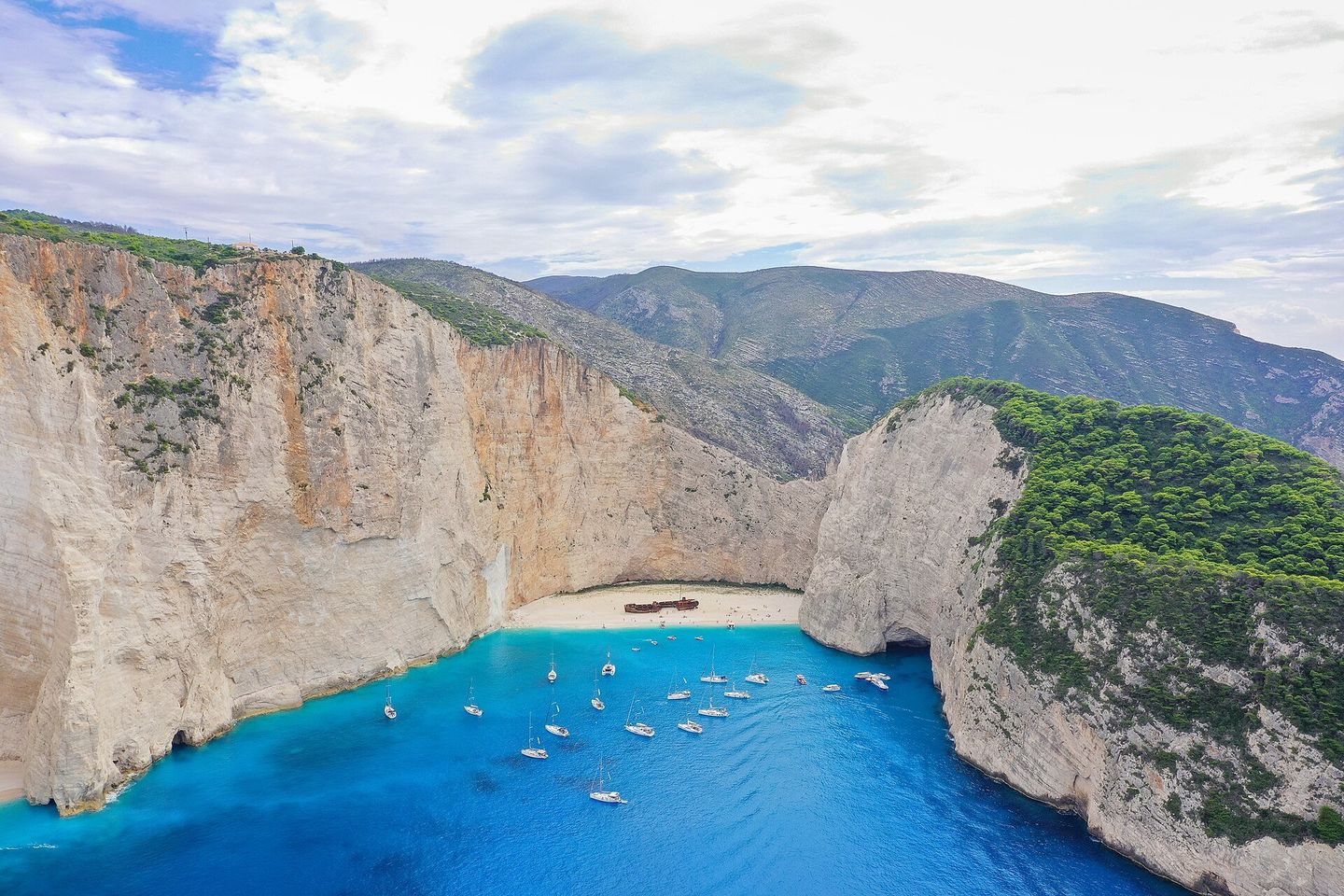
One photograph does most of the work of selling Zakynthos: a rusted hull beached on a crescent of white sand, boxed in by limestone cliffs, water somewhere between turquoise and glass. That image is real, it is called Navagio, and it is exactly as good in person as it looks online. It is also roughly one-fiftieth of what the island actually is, and the visitors who treat it as the whole itinerary tend to leave having seen a cliff-top viewpoint, a crowded boat deck, and not much else.
The rest of Zakynthos — Zante, if you use the Venetian name that locals still favour — is a slower story. This is the island that produced Dionysios Solomos, the poet whose verses became the Greek national anthem, and the Chora, its capital, carries that literary, slightly melancholic self-regard even though the 1953 earthquake flattened almost every building the Venetians and the Ionian aristocracy had put up over three centuries. What stands today is a careful, arcaded reconstruction — handsome, a little theatrical, and far less visited than the beaches that made the island famous.
Zakynthos also happens to host one of the Mediterranean's most important loggerhead sea turtle nesting grounds, right inside the bay where most of the package resorts sit, which has produced one of Greece's odder and more admirable experiments in regulated tourism. Base yourself well, build in at least one full day away from the boat-tour circuit, and the island gives you something considerably richer than the postcard: a place that is simultaneously a serious nature reserve, a half-rebuilt Venetian outpost, and a very good, very straightforward beach holiday, often within the same afternoon.
The caseWhy Zakynthos earns more than a day trip
Treat Zakynthos as a one-view island and you will see Navagio from a packed viewpoint or a crowded boat, tick it off, and miss the reasons people come back. The geology alone is doing more work than most visitors give it credit for: the west coast is a wall of sheer limestone cliffs riddled with sea caves, the Blue Caves at Cape Skinari chief among them, where sunlight bounces off the white seabed and turns the water inside an almost unreal electric blue. The east and south coasts flatten out into the long, gentle sand of Laganas Bay, which is precisely why loggerhead turtles have nested there for longer than anyone has been counting, and why the bay is now a protected marine park rather than simply another strip of sun loungers.
The island's human history has the same push-pull quality. Venice held Zakynthos for nearly two centuries longer than most of the rest of Greece felt its influence, which is why the Chora's café culture, its arcaded main square, and its taste for Italianate serenades called kantades feel distinct from the mainland even now. Then came the earthquake of 1953, which killed dozens and reduced the old town to rubble in under a minute, and the island rebuilt itself in a lower, sturdier, more deliberately uniform style that is its own kind of monument. Spend a few days moving between the cliffs, the turtle bay, and the rebuilt town, and Zakynthos stops being a single photograph and starts being a place with an actual, layered personality.
The calendarWhen to go
Late May through June and the first half of September are the island's best weeks. The sea has warmed up without the peak-July crush, wildflowers are still finishing their run on the inland hills in late spring, and the loggerhead turtles are actively nesting from roughly late May through August, with hatchlings emerging into early autumn — reason enough on its own to avoid the deepest midsummer stretch if turtle-watching is part of the draw, since nesting beaches enforce strict quiet hours and lighting rules precisely when demand to visit them peaks.
July and August bring the full package-holiday crowd to Laganas and Tsilivi, reliable heat in the mid-thirties Celsius, and the highest boat-tour prices and longest queues at Navagio's viewpoint and the Blue Caves. It is also, bluntly, the only realistic window for travellers tied to school holidays, and the island copes with it well if you build in quieter counter-programming — the Chora, Bochali at sunset, the inland villages — rather than stacking beach day after beach day. Winter all but shuts the island's tourist machinery down; most hotels, boat operators and beach bars close entirely from late October to April, so this is a firmly seasonal destination rather than a year-round one.
LogisticsGetting around
Zakynthos International Airport sits just south of the Chora, close enough that several of the island's resort strips are a twenty-minute transfer or less — a rare stroke of geographic luck for a Greek island. Ferries also run from Kyllini on the Peloponnesian mainland to the port just below the Chora, a journey of roughly an hour, which is the budget route in from the mainland and the one most independent travellers without a flight into Zakynthos itself will use.
A rental car is close to essential if you want to see more than your resort strip. Public buses exist, radiating from the Chora's KTEL station out to the main beach towns, but schedules thin out fast once you're past the obvious routes, and the island's best moments — a quiet turn-off toward Porto Limnionas, an unscheduled stop at a hill village taverna — are exactly the ones a bus timetable won't accommodate. Roads into the interior and down to the west-coast viewpoints are narrow, switchbacked and occasionally vertigo-inducing; drive them in daylight the first time, and budget more time than the map distance suggests. Taxis and organised transfers cover the gaps for anyone who'd rather not drive.
The tableHow Zakynthians actually eat
Zakynthian cooking carries a heavier Venetian and Ionian accent than the food on most Aegean islands, and the island's defining dish makes the point directly: sartsa, a rich tomato-based meat sauce closer in spirit to a Mediterranean ragù than to anything you'd call typically Greek, usually ladled over pasta rather than rice. Look for it on tavernas' handwritten specials rather than the laminated tourist menu, which is usually the better filter for food generally on this island.
The other local signature is liquid: Verdea, a pale, slightly oxidised white wine made from grapes dried briefly before pressing, produced almost nowhere else, and worth seeking out specifically rather than defaulting to the house white. Inland villages are where the more distinctive eating happens — wild greens, local cheeses, honey from the hill country around Askos and Exo Chora — while the coastal resort strips skew toward fine but interchangeable grilled-fish-and-salad tourist fare. Kantades, the Venetian-inflected serenades sung with guitar and mandolin, still turn up at tavernas in and around the Chora on summer evenings; if you hear one starting, it's worth lingering over dessert rather than rushing to the next stop.
The mapCoasts and towns to know
Zakynthos Town — the Chora — is the island's rebuilt capital: arcaded streets around Solomos Square, the hilltop Venetian castle at Bochali looming just above, and by far the best base for anyone who wants culture and a working town alongside their beach days, at the cost of being a drive or a bus from the most famous sand. Tsilivi, a short hop north, is the easiest all-rounder — sandy, family-friendly, close to the airport and the Chora both, without tipping into the full package-holiday intensity of the south.
Laganas and neighbouring Kalamaki anchor the south, directly on the turtle-nesting bay, which means the liveliest nightlife on the island sits a few hundred metres from a protected marine park — an odd but functioning coexistence, with strict rules on beach lighting, sunbeds and noise after dark during nesting season. Alykes and Alykanas, on the calmer northeast coast, trade some of that energy for a quieter, more family-oriented strip facing toward the mainland. Vasilikos, the long peninsula in the southeast, has the island's best under-the-radar beaches — Gerakas and Porto Roma among them — and rewards anyone willing to drive a little further for noticeably less crowded sand.
Field intelligencePractical intelligence
The turtle rules are not a suggestion. Laganas Bay is a designated marine park specifically to protect loggerhead nesting beaches, and during nesting and hatching season (roughly May to October) there are real restrictions: no beach furniture or vehicles on protected sand after dark, no bright lights facing the beach from nearby properties, and boats are required to keep a legal distance from turtles in the water. Breaking these isn't just antisocial here, it's enforced — treat any posted sign seriously rather than as scenery.
Navagio itself has no safe land access for the general public; the old cliff staircase down to the beach is closed following rockfall incidents, so visiting means a boat trip from Porto Vromi, Agios Nikolaos or around the island, and the photographed cliff-top viewpoint above is a separate, short drive-and-walk from the beach itself — budget time for both if you want the classic shot and the sand. West-coast roads are narrow and cliff-edged with limited guardrails; rent a car you're genuinely comfortable driving on switchbacks, and don't attempt the drop into Porto Vromi in the dark. Cash still rules in smaller tavernas and beach-bar kiosks away from the main resort strips, so carry some even if your hotel takes cards everywhere.
What to see & do
-
Navagio (Shipwreck Beach)
The island's single most photographed spot: a rusting hull grounded on white sand inside a cliff-walled cove, reachable only by boat or from the famous viewpoint above.
Tip:Take an early-morning boat from Porto Vromi before the midday flotilla arrives, and visit the cliff-top viewpoint as a separate stop rather than expecting to combine both in one trip.
-
The Blue Caves
A string of sea caves cut into the cliffs at Cape Skinari, where sunlight reflecting off the white seabed turns the water inside an intense, almost artificial blue.
Tip:Go on a calm, sunny morning — rough seas close the caves to boats, and the blue effect depends entirely on direct light hitting the water.
-
Zakynthos Town & Solomos Square
The rebuilt Venetian-style capital, arcaded streets wrapped around the square named for the island's most famous son, the poet whose verses became Greece's national anthem.
Tip:Visit the small Solomos Museum just off the square for the clearest, least touristy account of the island's literary and earthquake history.
-
Bochali & the Venetian Castle
A hilltop fortress and viewpoint directly above the Chora, with the best sunset panorama on the island over the town, the harbour and the strait toward the mainland.
Tip:Arrive an hour before sunset to walk the castle walls in daylight, then stay for the view as the lights come on below.
-
Marathonisi (Turtle Island) boat trips
A small, uninhabited islet inside Laganas Bay, the heart of the marine park's turtle-watching boat trips, where sightings of loggerheads surfacing beside the boat are common in season.
Tip:Book with an operator that keeps engines idle and distance from any turtle at the surface — the reputable boats advertise this explicitly, and it's worth choosing on that basis alone.
-
Keri Lighthouse & Caves
The island's southwestern tip, pairing a working lighthouse on dramatic cliffs with sea caves below that are a popular, slightly calmer alternative to the Blue Caves for a sunset boat trip.
Tip:Sunset cruises from Keri village are less crowded than the equivalent Navagio or Blue Caves trips and are worth booking specifically for that reason.
-
Askos Stone Village
A restored hillside hamlet of old stone farm buildings turned into a free-roaming small zoo and botanical walk, a genuinely different, cooler-climate counterpoint to a day of beaches.
Tip:Go in the morning before the heat builds — most of the walk is outdoors and shade is limited in the hottest months.
-
Vasilikos beaches (Gerakas & Porto Roma)
The long southeastern peninsula's string of quieter sandy coves, including Gerakas, itself a protected turtle-nesting beach with restricted hours, and the calmer family strip at Porto Roma.
Tip:Gerakas closes to sunbeds and loungers after a set evening hour in nesting season — check current posted times locally rather than assuming all-day access.
On the groundWhere things are
Map data © OpenStreetMap contributors.
Where to stayBase yourself well
Zakynthos Town (Chora)
Best for culture-first visitors and those without a carThe working capital — arcaded streets, the main museums, the castle hill at Bochali, and the island's best everyday food scene, with the trade-off of being a drive from the famous beaches.
A small hotel near Solomos Square
Staying inside the Chora means walking to the museums, the harbourfront and the castle path, with buses to the beach towns from the nearby KTEL station.
€€A guesthouse on the lower slopes of Bochali
A short uphill walk from the centre buys a quieter night and an easy sunset stroll to the castle.
€€Tsilivi
Best for first-time visitors and familiesThe easy all-rounder — sandy beach, close to the airport and the Chora, family-friendly without the full intensity of the southern resort strip.
A beachfront family hotel in Tsilivi
Look for a property directly on the sand rather than across the coast road, since the walk back from dinner matters more here than the room view.
€€€A self-catering apartment a short walk from the beach
Tsilivi's apartment stock is strong value for groups who want a kitchen and don't need to be directly beachfront.
€€Laganas & Kalamaki
Best for nightlife-focused groupsThe liveliest nightlife on the island, directly on the turtle-nesting bay — bars and beach clubs a few hundred metres from a protected marine park, under strict seasonal lighting and noise rules.
A resort hotel set back from the main Laganas strip
A short walk from the bars without being directly above the loudest stretch makes a real difference to sleep.
€€Alykes & Alykanas
Best for families wanting quieter eveningsThe calmer northeast coast, facing toward the mainland — a gentler, more family-oriented alternative to the south with its own long sandy beach.
A mid-size family hotel in Alykanas
This stretch has shallower water than much of the island, a real plus for families with younger children.
€€Vasilikos & Porto Roma
Best for travellers who want beach over nightlifeThe quieter southeastern peninsula — fewer bars, better sand, and the closest beaches to Gerakas's protected turtle-nesting stretch.
A small hotel near Porto Roma
Staying this far out trades convenience for genuinely quieter beaches and a slower pace; a car is close to essential here.
€€Affiliate notePostcardRoute is reader-supported. Some links to Booking.com (stays, flights, car hire, tickets and tours, airport transfers) are affiliate links, tracked through CJ Affiliate: if you book through them we may earn a small commission at no extra cost to you. We only recommend places we would send a friend.
Book the restEverything else for the trip
Stay sorted? These open Booking.com for the other legs of the journey.
-
Tours & tickets
Things to do in Zakynthos
Skip-the-line tickets, tours and day trips.
Browse activities -
Wheels
Car hire in Zakynthos
Compare pick-up points and rental companies.
Compare cars -
Air
Flights
Search fares, then come back for the neighbourhood advice.
Search flights -
Ground
Airport transfers
Book a taxi or private transfer before you land.
Book a transfer
Affiliate noteThese four links are affiliate links too: if you book through them we may earn a small commission at no extra cost to you.
Beyond the cityWorthwhile day trips
- Navagio & Blue Caves boat circuit
The classic combined half-day boat trip, usually departing Porto Vromi or Agios Nikolaos, pairing the Shipwreck Beach cove with the Blue Caves at Cape Skinari in a single outing.
- Marathonisi & Laganas Bay turtle-watching
A gentler, flat-water boat trip into the marine park around Turtle Island, with a strong chance of surfacing loggerheads alongside a swim stop on quieter sand.
- Keri Caves sunset cruise
A smaller, less crowded alternative to the Blue Caves run, timed for sunset light on the cliffs at the island's southwestern tip.
- Askos and the hill villages
A half-day inland loop through Askos Stone Village and the quieter hamlets of the island's interior, a genuine change of register from a week of beaches and boats.
Before you goCommon questions
- How many days do you need in Zakynthos?
- Five to seven days lets you properly split time between the west-coast boat excursions, the turtle-watching trips in Laganas Bay, the Chora, and at least one beach day with nothing on the agenda. Three days is enough to see Navagio, the Blue Caves and the Chora, but it will feel rushed.
- What is the best area to stay in Zakynthos?
- Tsilivi is the easiest all-round base — sandy, central, close to the airport and the Chora. Stay in Zakynthos Town itself if culture and walkability matter more than beachfront; choose Laganas or Kalamaki for nightlife, or Vasilikos and Alykanas for a quieter pace.
- Can you actually see turtles in Zakynthos?
- Yes, reliably, via boat trips into Laganas Bay's marine park, especially around Marathonisi (Turtle Island) in the nesting and hatching season from roughly May to October. Choose an operator that keeps a respectful distance and idles engines near surfacing turtles rather than one that chases them for photos.
- How do you get to Navagio (Shipwreck) Beach?
- By boat only — the old cliff staircase down to the sand is closed after rockfalls. Boats run from Porto Vromi, Agios Nikolaos and as part of island-circuit tours. The famous cliff-top photo viewpoint above the beach is a separate stop, reached by road and a short walk, not from the beach itself.
- Is Zakynthos good for families?
- Very, particularly Tsilivi and Alykanas, both of which have gentle sand and shallow water geared toward younger children, alongside genuinely engaging add-ons like the turtle-watching boat trips and Askos Stone Village.
- What is the best time of year to visit Zakynthos?
- Late May to June and the first half of September give you warm sea, lighter crowds and lower prices than peak summer. July and August are hottest and busiest, with the added complication of nesting-season restrictions on the beaches around Laganas Bay.
- Do you need a car in Zakynthos?
- For anything beyond your resort beach, yes. Buses connect the Chora to the main towns but thin out fast on cross-island and inland routes, and the best moments on this island — a quiet cove, a hill village taverna — are rarely on a bus timetable.