
Spain · Castilla-La Mancha
Toledo, the city of three faiths
A granite hill wrapped three-quarters round by the Tajo, stacked with a cathedral, a fortress and the best-preserved medieval Jewish quarter in Spain — all inside a walk you can finish by lunch, if you insist on wasting it.
A walled hill of three faiths, built on the ruins of every empire that wanted it · 39.86° N · 4.03° W
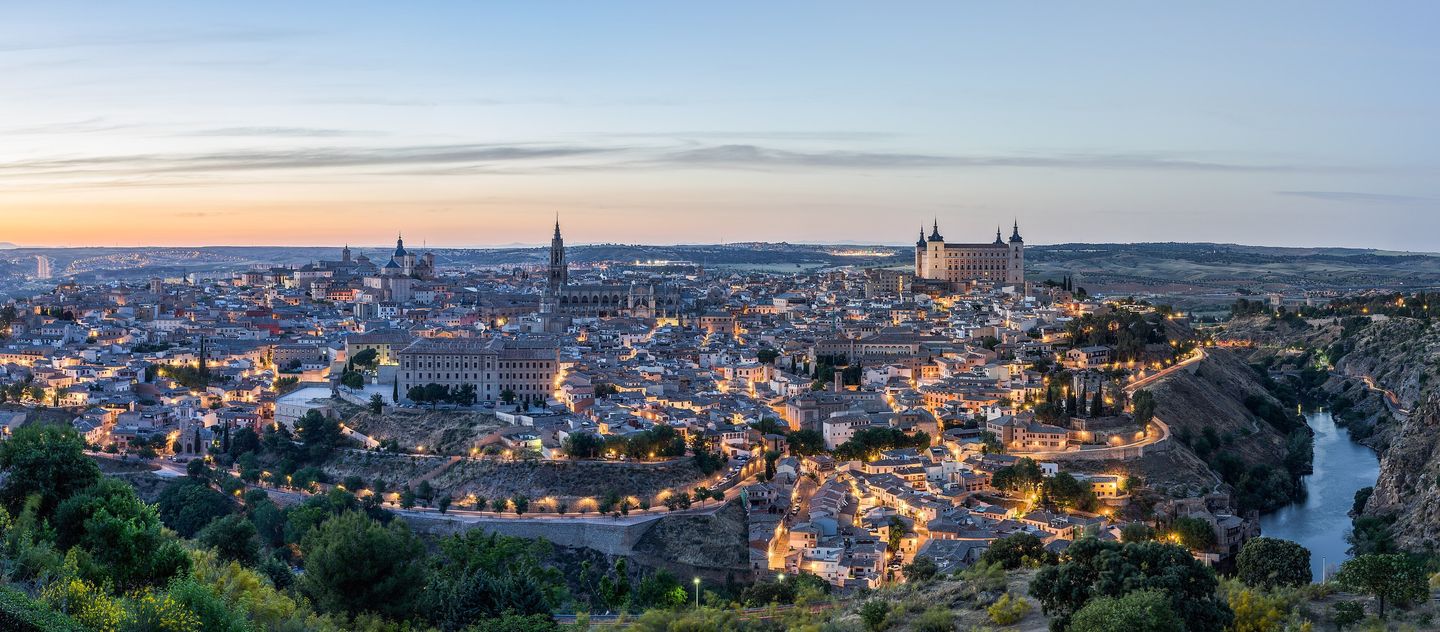
Most visitors meet Toledo as a bus-tour footnote: an hour off the coach, a photo of the skyline from across the gorge, a box of marzipan bought on the way back to the car park. That version of the city is real, but it is a fraction of what is actually here. Toledo spent the better part of a thousand years as the working capital of a Spain that belonged, at various points, to Visigoths, the Caliphate of Córdoba, Castilian kings and a Sephardic Jewish community large enough to leave behind the finest medieval synagogues in Western Europe — and almost all of that layered history is still standing, stacked onto a single granite hill wrapped on three sides by the Tajo River.
The nickname 'City of the Three Cultures' is not tourist-board poetry. For several centuries under Castilian rule, Toledo's Christian, Muslim and Jewish communities lived in genuine, if uneven, proximity — building churches that were once mosques, carving synagogues with the same horseshoe-arch plasterwork as Córdoba's great mosque, and producing a court culture of translators who funneled Greek and Arabic scholarship into medieval Europe. That coexistence ended badly, in expulsion and inquisition, but the physical evidence of it never got demolished the way it did in so many other Spanish cities. Walk ten minutes in the Judería and you pass a mosque converted to a hermitage, a synagogue converted to a church, and a cathedral built squarely on the site of the old mosque, all within sight of each other.
This is also, bluntly, a very good day trip from Madrid — thirty minutes by high-speed train — and that fact shapes everything about how to visit well. The streets fill with day-trip groups from mid-morning to late afternoon and empty out almost completely by early evening, which means the single best piece of advice in this guide is also the simplest: stay the night. The old town after the last tour bus leaves, with the floodlit cathedral and empty Judería lanes, is a genuinely different city from the one in the daytime photographs.
The caseWhy Toledo earns more than a half-day
Toledo was Spain's political and religious capital for centuries before Madrid existed as anything more than a hunting village, and it still carries the architectural weight of that role. The cathedral is one of the great Gothic buildings of Europe, stuffed with an El Greco altarpiece and a sacristy hung with more El Grecos, Goyas and Titians than most national museums manage. The Alcázar dominates the skyline from every angle and has been fought over, burned and rebuilt more times than almost any fortress in Spain. And the Judería holds two surviving medieval synagogues within five minutes' walk of each other, a density that exists nowhere else in the country.
What makes Toledo different from a typical cathedral-and-castle town is the texture underneath the headline sights: horseshoe arches on a converted mosque tucked into a quiet backstreet, Mudéjar brickwork patterns repeated across buildings built centuries apart, swordsmiths still working the damascene-inlay craft the city has practiced since Roman times. None of it demands a ticket to notice. You just have to walk slowly enough to see it, which the day-trip crowds, moving in a tight schedule back to Madrid, generally do not.
The calendarWhen to go
Spring (April to early June) and autumn (September to October) are the right windows. Castilla-La Mancha has a genuinely harsh continental climate — not the ocean-tempered heat of coastal Spain — and Toledo in July and August regularly sits above 35°C with little shade in the old town's stone lanes. If you must visit in summer, do everything before 11am and after 6pm, and treat the early afternoon as a siesta, the way the city itself effectively does.
Holy Week (Semana Santa) and Corpus Christi, which Toledo celebrates with an elaborate procession dating to the 13th century and flower-strewn streets, are spectacular but pack the old town solid — book accommodation months ahead if you want to be there for either. Winter is colder than most visitors expect for Spain, with occasional frost, but it is also the quietest and cheapest season and the cathedral's stonework photographs beautifully under grey winter light.
LogisticsGetting around
Toledo's old town is compact — under a kilometre across at its widest — but it is also built on a steep hill, and the streets inside the walls are a genuine medieval tangle that defeats phone navigation more often than it should. From the train station, it is a 20-25 minute uphill walk into the centre, or a short ride on bus L1/L2, which loops up to Plaza de Zocodover, the old town's natural hub. A set of outdoor escalators (the escalators mecánicas) climbs the steepest section near the Remedios slope and is a genuine mercy with luggage.
Inside the walls, everything worth seeing is within a twenty-minute walk of Zocodover, so a car adds nothing but parking stress — leave it at one of the free lots just outside the walls (Paseo de Recaredo, near the Alcántara bridge) if you're driving in from elsewhere in Castilla-La Mancha. The high-speed AVE train from Madrid Atocha is genuinely the best way in: thirty minutes, frequent departures, and it drops you well below the old town rather than in traffic.
The tableWhat to eat
Toledo's kitchen runs on game and partridge country cooking rather than seafood or the lighter dishes of coastal Spain. Perdiz estofada (stewed partridge) and carcamusas (a slow pork-and-tomato stew that originated in a specific Toledo bar, La Perdiz, in the 1950s and has since become the city's unofficial dish) are the two things to actually order. Migas — fried breadcrumbs with chorizo and garlic, a shepherd's dish from the surrounding plains — shows up on most traditional menus too, and the local queso manchego, from the sheep-farming country just south, is some of the best in Spain.
Mazapán (marzipan) is Toledo's famous sweet, traditionally made by nuns and sold in boxes stamped with convent names — Santo Tomé is the long-standing name to look for, with a shop a few steps from the monastery of the same name. It is worth buying from an actual bakery rather than a tourist-strip stall; the almond-to-sugar ratio in the mass-produced version is noticeably worse. For a sit-down meal, head slightly away from Zocodover's tourist-menu restaurants toward the streets around the cathedral or down into the Judería, where prices drop and the kitchens cook for locals as much as visitors.
The mapNeighbourhoods to know
The Judería, the old Jewish quarter in the city's southwest corner, is the single best area to simply wander — narrow whitewashed lanes, both surviving synagogues, artisan workshops selling damascene-inlay swords and jewellery, and noticeably fewer crowds than the streets around the cathedral. Plaza de Zocodover, the old town's main square, is the practical centre: cafés, the start of most walking routes, and the terminus for buses from the station.
The streets immediately around the Cathedral and the Alcázar carry the heaviest day-trip foot traffic and the highest concentration of souvenir shops — worth seeing for the monuments themselves, less worth lingering in for atmosphere. Across the Tajo, the Cigarrales district and the road up to the Mirador del Valle give the postcard view back at the city and are where locals actually go for a quiet evening walk, away from the old town entirely.
Field intelligencePractical intelligence
Many of Toledo's smaller monuments and churches close for a long midday break and all day Monday — check specific hours before building a tight itinerary, especially for the synagogues and the Mezquita del Cristo de la Luz. A combined ticket covering several of the main monuments (sold at the tourism office on Zocodover) saves money if you're visiting four or more sights, though the Cathedral and Alcázar's Army Museum are ticketed separately.
Toledo is a genuinely steep, cobbled city — bring proper shoes, not sandals, and budget more time between sights than the map distances suggest. The Mirador del Valle viewpoint, reachable by a short taxi or a committed uphill walk across the Alcántara bridge, is worth the detour specifically at golden hour; it is the single photograph everyone is actually trying to get of the skyline, and it is free.
What to see & do
-
Toledo Cathedral (Catedral Primada)
Spain's primatial cathedral and one of the great Gothic buildings in Europe, built over 250 years on the site of the city's main mosque, with a sacristy holding an extraordinary run of El Grecos, Goyas and Titians.
Tip:Buy the combined ticket that includes the sacristy and treasury — skipping them to just see the nave misses most of the actual art.
-
Alcázar de Toledo
The fortress that dominates every photograph of the skyline, rebuilt repeatedly since Roman times and most recently after a devastating 1936 siege during the Spanish Civil War; now home to Spain's national Army Museum.
Tip:The museum itself is a genuinely good, modern collection — don't just photograph the exterior and move on.
-
Sinagoga del Tránsito
A 14th-century synagogue built for a Christian king's Jewish treasurer, its walls covered in Mudéjar plasterwork and Hebrew inscriptions, now housing Spain's Sephardic Museum.
Tip:Read the small museum galleries properly — they explain the Sephardic expulsion in a way that reframes everything else you'll see in the Judería.
-
Sinagoga de Santa María la Blanca
An even older synagogue, consecrated as a church after the 1492 expulsion, whose horseshoe arches and whitewashed capitals look startlingly like Córdoba's Mezquita in miniature.
Tip:Visit both this and the Tránsito synagogue in the same walk — they're five minutes apart and the contrast in scale and decoration is the point.
-
Mezquita del Cristo de la Luz
A small 10th-century mosque, one of the oldest Islamic buildings in Spain, later consecrated as a church with a Mudéjar apse grafted onto the original horseshoe-arched prayer hall.
Tip:It's tiny and easy to walk past — look for the unassuming brick facade near the Puerta del Sol gate.
-
Monasterio de San Juan de los Reyes
A Franciscan monastery built by Ferdinand and Isabella to celebrate their dynastic union, with a cloister of exuberant late-Gothic stonework and chains from freed Christian captives hung on its facade.
Tip:The upper cloister gallery has the best detail on the carved frieze — don't stop at ground level.
-
Puente de San Martín
A medieval stone bridge spanning the Tajo gorge on the city's western edge, with a fortified gatehouse tower at one end and one of the quietest, least-crowded views of the old town walls.
Tip:Cross it at sunset and look back rather than continuing on — the walls catch the light better than the view ahead.
-
Mirador del Valle
The viewpoint across the Tajo gorge that produces the single image everyone associates with Toledo: the whole old town, cathedral spire and Alcázar stacked above the river bend.
Tip:Go for golden hour, not midday — the low light rakes across the stone and the colour shift in twenty minutes is dramatic.
-
Museo del Greco
A reconstructed period house near the artist's actual former residence in the Judería, built to evoke the Toledo El Greco painted in rather than a straightforward biographical museum.
Tip:Pair it with the cathedral sacristy's El Grecos the same day — the museum gives useful context for what you've just seen there.
On the groundWhere things are
Map data © OpenStreetMap contributors.
Where to stayBase yourself well
Inside the walls, near Zocodover
Best for first-timers who want everything on footThe most central possible base, steps from the cathedral and the start of every walking route, inside a genuine medieval street plan. Expect noise from day-trip crowds until early evening and real quiet after.
A small hotel in a converted historic townhouse near the Cathedral
Old-town stone buildings here are genuinely centuries old; ask for a room away from the street-facing side if you're a light sleeper.
€€€A boutique guesthouse just off Plaza de Zocodover
You're paying for the five-minute walk to everything — fine value once the day-trip crowds thin after 6pm.
€€The Judería
Best for atmosphere over convenienceQuieter, narrower, and arguably more atmospheric than the cathedral district — whitewashed lanes, artisan workshops, and both surviving synagogues on your doorstep. Slightly less convenient for the Alcázar side of town.
A restored house-hotel in the old Jewish quarter
Several Judería properties are converted from centuries-old townhouses with small interior courtyards — ask before booking if that matters to you.
€€€Across the Tajo (Cigarrales / Parador district)
Best for the view, and travellers with a carOutside the walls entirely, on the hillside opposite the old town, trading walkability for the postcard view back at the city and easier parking. You'll need a short taxi or bus into the centre each day.
A hillside hotel near the Mirador del Valle road
Rooms facing the gorge get the skyline view for free; it's the same vista everyone else drives up for at sunset.
€€€The new town, near the train station
Best for budget and train-schedule convenienceModern, cheaper, and less charming — but a flat, short walk or bus ride to the AVE station, and useful if you're arriving late or leaving early.
A straightforward business-style hotel near the station
No old-town atmosphere, but noticeably lower rates and an easy roll-on to the train for an early departure.
€Affiliate notePostcardRoute is reader-supported. Some links to Booking.com (stays, flights, car hire, tickets and tours, airport transfers) are affiliate links, tracked through CJ Affiliate: if you book through them we may earn a small commission at no extra cost to you. We only recommend places we would send a friend.
Book the restEverything else for the trip
Stay sorted? These open Booking.com for the other legs of the journey.
-
Tours & tickets
Things to do in Toledo
Skip-the-line tickets, tours and day trips.
Browse activities -
Wheels
Car hire in Toledo
Compare pick-up points and rental companies.
Compare cars -
Air
Flights
Search fares, then come back for the neighbourhood advice.
Search flights -
Ground
Airport transfers
Book a taxi or private transfer before you land.
Book a transfer
Affiliate noteThese four links are affiliate links too: if you book through them we may earn a small commission at no extra cost to you.
Beyond the cityWorthwhile day trips
- Madrid
Thirty minutes by AVE in the other direction — easily reversed as a day trip if you've based yourself in Toledo instead, with trains frequent enough to plan around rather than around them.
- Consuegra
An hour south by car or bus, to the row of whitewashed windmills on a ridge above town that inspired Cervantes's Don Quixote — genuinely striking at sunset, and almost nobody stays past the photo.
- Aranjuez
A UNESCO-listed royal palace and gardens about 45 minutes away, built as the Spanish monarchy's spring residence — grander and less crowded than its reputation as a minor stop suggests.
Before you goCommon questions
- Is Toledo worth visiting as a day trip from Madrid?
- Yes, and it's genuinely one of the best day trips from Madrid — 30 minutes each way by AVE train. That said, the old town is noticeably better after the day-trip tour groups leave in late afternoon, so an overnight stay, even just one, shows you a very different, quieter city.
- How many days do you need in Toledo?
- A full day covers the cathedral, the Alcázar and the Judería's two synagogues at a reasonable pace. Two days lets you add the smaller sights — the Mezquita del Cristo de la Luz, the Museo del Greco, San Juan de los Reyes — without rushing, plus an evening and a morning when the streets are empty.
- What is Toledo famous for?
- Its 'City of Three Cultures' history — the coexistence, and later expulsion, of Christian, Muslim and Jewish communities, visible today in a cathedral built over a mosque and two surviving medieval synagogues. It's also historically known for damascene steel craftsmanship and marzipan, and for being El Greco's adopted home.
- Is Toledo expensive to visit?
- It's generally cheaper than Madrid or Barcelona for food and lodging, though prices rise sharply for anything directly on Plaza de Zocodover or immediately around the cathedral. Walk a few streets into the Judería or toward the new town and both meals and rooms get noticeably better value.
- What is the best time of year to visit Toledo?
- Spring (April–June) and autumn (September–October), for mild weather in what is otherwise a harsh continental climate. Summer regularly exceeds 35°C with little shade in the old town; winter is cold but quiet, cheap, and good for photographing the stonework under flat grey light.
- Do I need to book tickets in advance for the Cathedral or Alcázar?
- It helps in peak season (spring, early autumn, and any major religious festival) but isn't usually essential outside of Holy Week or Corpus Christi, when the whole city books out. Buying the combined monument ticket online ahead of a summer weekend visit still saves queueing time at the door.