
Spain · Andalusia
Ronda, split down the middle
A mountaintop town cut in two by a gorge 100 metres deep, crossed by a bridge that took forty-two years to get right. Everything else here is in its shadow, happily.
A town split in half by a 100-metre gorge, and in no hurry to fix it · 36.72° N · 5.16° W
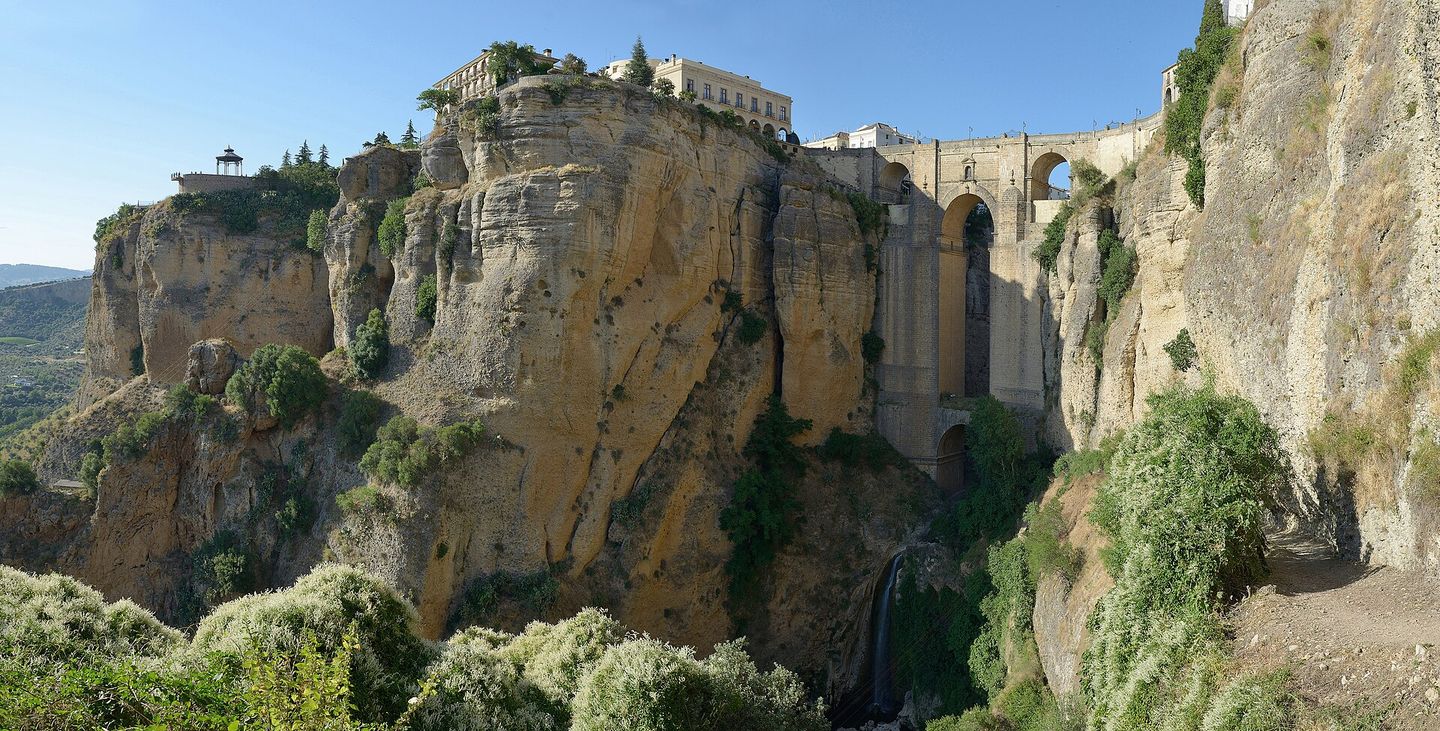
Most towns have a river or a hill to organise themselves around. Ronda has a wound. El Tajo gorge drops a sheer hundred metres through the rock the town sits on, splitting Ronda into two halves that stare at each other across empty air, and the only thing holding the place together, literally, is a stone bridge that took forty-two years, two failed predecessors and dozens of lives to finally get right. That bridge, the Puente Nuevo, is now the single most photographed object in inland Andalusia, and it deserves the attention — but it is also, in a strange way, the least interesting thing about Ronda once you have crossed it.
What the bridge buys you access to is a town that has spent five centuries quietly accumulating reasons to linger: a Moorish old quarter that never bothered converting itself into a theme park, one of the oldest and most important bullrings in Spain sitting almost apologetically at the edge of a public park, a wine region nobody outside Spain talks about, and a position in the hills above the Costa del Sol that makes it the natural hinge between the beach crowds on the coast and the genuinely rural Andalusia of the pueblos blancos further inland. Hemingway came through, Rilke lived here for weeks trying to write a single poem about the gorge, and Orson Welles asked, on his death, to have his ashes scattered on a friend's finca just outside town. Ronda has always attracted people who wanted to look at something for a long time without being interrupted.
This isn't a list of ten things to photograph from the bridge and leave. What follows is the case for giving Ronda a night or two rather than a lunch stop on the way to somewhere else — where to actually stay given the two halves of town pull in different directions, when the light and the crowds make the gorge worth seeing properly, and the practical texture of a town that is, underneath the postcard, a real working mountain community rather than a backdrop.
The caseWhy Ronda earns the detour
Every hill town in Andalusia claims a view. Ronda's is different in kind, not just degree — El Tajo isn't a vista you look out at, it's a void you walk across, and the vertigo of standing on the Puente Nuevo with a hundred metres of nothing under your feet is an experience no photograph of the bridge from below quite prepares you for. That alone would justify a stop. What justifies staying is everything the gorge happens to divide: La Ciudad, the old Moorish town on the southern side, is one of the least-touristed historic cores of its size in Spain, a genuine warren of narrow lanes, mudéjar churches built over mosques, and houses that still function as houses rather than gift shops.
Ronda is also the spiritual home of modern Spanish bullfighting — Pedro Romero, the 18th-century matador credited with formalising the modern style, was from here, and the Plaza de Toros de Ronda is one of the oldest purpose-built bullrings in the country, whatever your views on the sport itself. Add a wine region (Ronda DO) that barely exports outside Andalusia, a mountain range with genuinely good hiking fifteen minutes from the centre, and a prehistoric cave fifteen kilometres out with 25,000-year-old paintings that predate Lascaux's fame but see a fraction of the crowds, and the case for more than an afternoon writes itself.
The calendarWhen to go
Ronda sits at over 700 metres in the hills above the Costa del Sol, and that altitude changes everything about its climate relative to the beaches thirty minutes south. Summer on the coast is a different country from summer here — Ronda stays hot in July and August but noticeably drier and more bearable than Málaga or Marbella, with evenings that cool properly once the sun drops behind the gorge. Spring, roughly April through early June, is the strongest window: wildflowers across the Serranía, comfortable walking temperatures, and the Feria de Pedro Romero in early September still a safe distance off if you want to avoid the crowds it brings.
Autumn, September into November, is the connoisseur's choice — the wine harvest is on, the light across the gorge turns gold in exactly the way painters have been chasing here for two centuries, and the day-trip coaches from the coast thin out considerably after the summer peak. Winter is genuinely underrated: Ronda gets cold enough for an occasional dusting of snow on the surrounding peaks, the old town empties out almost entirely on weekdays, and the gorge in low winter light with mist pooling below the bridge is one of the more haunting things you'll see in Spain. Avoid the week of Semana Santa if you dislike crowds; Ronda's Holy Week processions are serious business and draw visitors from across the region.
LogisticsGetting around
Ronda is small enough to walk entirely, and you should — the historic centre on both sides of the gorge covers barely a kilometre end to end, and the town's whole appeal is in things you notice at walking pace: a doorway, a view down a side street, the sudden drop of the gorge appearing between buildings where you didn't expect it. The one genuine physical challenge is the gorge itself, which means a fair amount of up-and-down between El Mercadillo and La Ciudad regardless of which bridge or path you take; comfortable shoes matter more here than in most Andalusian towns.
Getting to Ronda without a car is entirely workable and arguably the better choice for a short stay. The train from Málaga and the one from Algeciras are both genuinely scenic routes through the mountains, cut through tunnels and along ridgelines in a way that makes the journey part of the trip rather than dead time. Buses connect reliably to Málaga, Seville and Marbella, usually faster than the train and more frequent. If you're basing yourself in Ronda to explore the wider Serranía — the cave paintings at La Pileta, the white villages of Grazalema and Zahara, the wineries scattered through the hills — a hire car becomes worth it, since public transport between those smaller villages thins out fast and a day trip without one can mean long waits for infrequent buses.
The tableMountain food, not beach food
Ronda eats like the mountain town it is rather than the coastal resort towns thirty minutes down the hill, and the difference is worth noticing. Game and slow-cooked meat dominate menus in a way you won't find on the Costa del Sol: rabo de toro (oxtail stew, traditionally made from bulls that fought in the ring) is the dish most associated with the town, rich and slow-braised until the meat falls apart, and you'll find a credible version at almost any traditional restaurant in La Ciudad. Chestnuts, wild mushrooms and partridge show up seasonally from the surrounding hills, alongside the jamón and cured meats you'd expect anywhere in this part of Spain.
The town's other quiet specialty is wine — Ronda DO is a small, serious appellation that most visitors to Andalusia never encounter because almost none of it leaves the region, grown on the plateaus around the town at an altitude that gives the reds a freshness you don't get from the hotter plains further north. A handful of bodegas within a short drive offer tastings, and more restaurants in town are putting local labels on the list rather than defaulting to Rioja. For something lighter, treat the Mercadillo side as the tapas side of town — it's where locals actually eat on a Tuesday night, cheaper and looser than the restaurants clustered for the view near the bridge.
The mapTwo towns, one gorge
Ronda's geography does most of the organising for you. La Ciudad, on the south side of El Tajo, is the old Moorish and early-Christian town — a tight tangle of lanes, the Santa María la Mayor church built directly over the former Friday mosque, the Palacio de Mondragón, and the Baños Árabes down near the river at the bottom of the gorge. It is quieter, more atmospheric after dark, and where you feel the town's deeper history most directly; it also has the better views down into the gorge itself, from the Jardines de Cuenca and the Mirador de Aldehuela.
El Mercadillo, on the north side, is the newer town — built up mostly from the 15th century onward once the Christian reconquest pushed the settlement outward — and it's where the bullring, the main shopping streets, the Alameda del Tajo park, and most of the hotels and restaurants with a bridge view actually sit. It's busier, more geared toward visitors, and the side you'll likely spend more waking hours in simply because it has more to do. The Puente Nuevo is the main link between the two, but don't skip the older, lower Puente Viejo and the Arabic-era Puente Árabe downstream — both still crossable, both far quieter, and both give you a view of the gorge and the newer bridge above that the Puente Nuevo itself can't offer.
Field intelligencePractical intelligence
The bridge's viewing platforms get genuinely crowded by mid-morning once the day-trip coaches arrive from the coast, so see the Puente Nuevo and the gorge viewpoints either before 9am or in the last two hours of light, when the coach groups have already left and the stone takes on a much better colour. The small Centro de Interpretación inside the bridge itself, reached via a staircase just beside the Parador, is a short but worthwhile stop — it's built into the old prison chamber that once sat inside the bridge structure and gives real context on the forty-two years and two bridge collapses it took to get the crossing right.
Much of the old town's charm is in alleys with uneven, worn stone, so trade sandals for proper shoes with grip, especially after rain. Ronda is doable as a day trip from Málaga, Seville or the Costa del Sol resorts, and plenty of visitors do exactly that — but the town empties of coach traffic by late afternoon, and what's left after 6pm, with the gorge turning amber and the old town settling into its actual rhythm, is the version of Ronda worth coming back for an overnight to see. Card payment is near-universal in restaurants and hotels, though smaller bars and market stalls still prefer cash.
What to see & do
-
Puente Nuevo
The 1793 stone bridge that finally conquered El Tajo gorge on the third attempt, after an earlier version collapsed and killed around fifty people six years after completion. Still the town's defining image, and its vertigo.
Tip:Walk down the staircase to the Centro de Interpretación inside the bridge's old prison chamber for the real story behind the two failed predecessors.
-
El Tajo Gorge & Jardines de Cuenca
The 100-metre chasm that splits the town in two, best appreciated from the terraced gardens on the La Ciudad side, which step down the cliff face toward the river below.
Tip:Come in the last hour of daylight, when the gorge walls turn gold and the day-trip crowds have mostly left.
-
Plaza de Toros de Ronda
One of the oldest and most important bullrings in Spain, built in 1785 and tied closely to Pedro Romero, the Ronda-born matador credited with codifying the modern style of bullfighting.
Tip:The on-site museum is worth the ticket even if you have no interest in attending a fight — it covers the ring's architecture and the Romero family's outsized role in the sport's history.
-
La Ciudad (the old Moorish quarter)
The tangled historic core on the gorge's southern side, including Santa María la Mayor church built over the town's former Friday mosque and the Palacio de Mondragón's Moorish courtyards.
Tip:Go without a fixed route — the quarter rewards aimless wandering more than any single sight inside it.
-
Casa del Rey Moro & La Mina staircase
Hanging terraced gardens above a disused 14th-century staircase, La Mina, carved directly into the gorge wall to give the old town secret access to the river during sieges.
Tip:The staircase itself is steep, damp and uneven — wear real shoes, and know there's no shortcut back up once you've descended.
-
Baños Árabes (Arab Baths)
Well-preserved 13th- and 14th-century Moorish bathhouses down by the river at the foot of the gorge, among the best-kept examples of their kind outside Granada.
Tip:Pair the visit with a walk along the river path below — it's the quietest, least-visited angle on the gorge and the bridges above it.
-
Cueva de la Pileta
A privately guarded cave twenty minutes outside town holding Palaeolithic paintings of animals and abstract symbols up to 25,000 years old, shown only on small, lantern-lit guided tours.
Tip:Book ahead by phone or email — tour groups are deliberately kept tiny and midday slots in high season fill up days in advance.
-
Setenil de las Bodegas
A nearby pueblo blanco built directly into an overhanging rock face, with whole streets of houses whose ceilings are the cliff itself — among the most photographed of Andalusia's white villages.
Tip:Visit early or late to get the famous rock-shaded streets without the midday tour-bus crush.
On the groundWhere things are
Map data © OpenStreetMap contributors.
Where to stayBase yourself well
La Ciudad (the old town)
Best for atmosphere and history over convenienceThe Moorish quarter south of the gorge — narrow lanes, the best gorge-garden views, and the quietest nights once the day-trippers leave. Slightly less convenient for the bullring and shopping streets.
A converted townhouse near the Palacio de Mondragón
Old-town stone houses here often open onto small interior courtyards — ask for a room with a gorge-facing window if one's available.
€€€A small guesthouse near Santa María la Mayor
Walking distance to the cathedral-church and the gorge gardens, with the old town's quieter character after dark.
€€El Mercadillo, near the bridge
Best for first-timers and short staysThe newer side, within a few minutes' walk of the Puente Nuevo viewpoints, the bullring and most restaurants. Busier by day, but the most convenient base for a short stay.
A hotel with a gorge-facing terrace near the Parador
Rooms directly overlooking El Tajo book out fastest in spring and autumn — reserve well ahead for a view room.
€€€€A mid-range hotel just off Calle Virgen de la Paz
A short, flat walk from the bridge and the bullring, with easier access for luggage than the old-town side.
€€Alameda del Tajo park edge
Best for travellers who want a slower, more local-feeling stayQuiet, residential, a few minutes further from the bridge but next to the town's main park and its own gorge-edge viewpoints — good for a calmer pace without sacrificing much walkability.
A family-run hotel facing the Alameda gardens
Mornings here mean the park rather than tour groups — a genuinely calm start to the day.
€€The Serranía countryside, just outside town
Best for longer stays and wine-country exploringRural fincas and small rural hotels scattered through the hills and vineyards surrounding Ronda — a car-dependent but rewarding base if you're combining the town with wine tastings or hiking.
A converted farmhouse among the Ronda DO vineyards
Several working bodegas in the surrounding countryside rent rooms alongside their tastings — ask about estate stays when you book a tasting.
€€€Affiliate notePostcardRoute is reader-supported. Some links to Booking.com (stays, flights, car hire, tickets and tours, airport transfers) are affiliate links, tracked through CJ Affiliate: if you book through them we may earn a small commission at no extra cost to you. We only recommend places we would send a friend.
Book the restEverything else for the trip
Stay sorted? These open Booking.com for the other legs of the journey.
-
Tours & tickets
Things to do
Tickets, tours and activities, anywhere.
Browse activities -
Wheels
Car hire
Compare rental companies worldwide.
Compare cars -
Air
Flights
Search fares, then come back for the neighbourhood advice.
Search flights -
Ground
Airport transfers
Book a taxi or private transfer before you land.
Book a transfer
Affiliate noteThese four links are affiliate links too: if you book through them we may earn a small commission at no extra cost to you.
Beyond the cityWorthwhile day trips
- Setenil de las Bodegas
A thirty-minute drive to a village built into an overhanging cliff face, famous for streets whose roofs are the rock itself — one of the most striking of Andalusia's white villages.
- Grazalema & the Sierra de Grazalema
A dramatic mountain village inside Spain's wettest natural park, with genuinely good hiking trails (including the permit-only Garganta Verde gorge walk) through limestone peaks and pine forest.
- Zahara de la Sierra
A hilltop white village crowned by a Moorish castle, overlooking a turquoise reservoir — one of the most photographed stops on the Ruta de los Pueblos Blancos.
- Ronda DO wine country
A scattering of small, serious bodegas across the plateaus around town, most offering tastings by appointment — a wine region most visitors to Spain have never heard of.
Before you goCommon questions
- Is Ronda worth visiting as a day trip?
- Yes, and most visitors do see it that way, usually from Málaga, Seville or the Costa del Sol. A day is enough for the bridge, the gorge viewpoints, the bullring and a wander through La Ciudad. But the town changes character after the coach groups leave in late afternoon, and an overnight lets you see the gorge in better light with a fraction of the crowds.
- How many days do you need in Ronda?
- One full day covers the headline sights comfortably. Two days lets you add a proper walk down into the gorge, the Arab baths, and either a wine tasting or a half-day trip to a nearby pueblo blanco like Setenil de las Bodegas or Zahara de la Sierra without feeling rushed.
- Which side of the gorge should I stay on, La Ciudad or El Mercadillo?
- El Mercadillo is more convenient for a short stay — closer to the bullring, main restaurants and transport. La Ciudad has more atmosphere and better gorge-garden views but means more walking on uneven lanes. For a single night, Mercadillo's convenience usually wins; for two or more, La Ciudad's quieter evenings are worth the extra steps.
- What is the best time of year to visit Ronda?
- April through early June and September through November are the strongest windows — comfortable temperatures, good light for the gorge, and lighter crowds than midsummer. Summer is hot but drier than the nearby coast; winter is quiet and atmospheric, with the chance of mist pooling below the bridge.
- How do you get to Ronda without a car?
- Trains run from both Málaga and Algeciras along genuinely scenic mountain routes, and buses connect reliably to Málaga, Seville and Marbella. A car becomes useful mainly if you plan to explore the smaller pueblos blancos or wineries in the surrounding Serranía, where public transport is far less frequent.
- Is the Puente Nuevo bridge free to visit?
- Walking across the bridge and viewing it from the public gardens and miradors is free. The small interpretation centre built into the bridge's old prison chamber, reached by a staircase beside the Parador, charges a modest entry fee and is worth the short stop for the history of the bridge's two failed predecessors.
- Is Ronda a good base for exploring the pueblos blancos?
- Very much so. Ronda sits roughly at the centre of the white-village region, within easy reach of Setenil de las Bodegas, Grazalema, Zahara de la Sierra and several others, and has better transport links and a wider choice of accommodation than any of the smaller villages around it.