
Greece · Crete
Heraklion works for a living
This is Crete's capital and its biggest port, not a resort town built for visitors — which is exactly why its markets, its ruins, and its harbour feel real.
Crete's working capital, with four thousand years stacked under the pavement · 35.34° N · 25.14° E
Most visitors to Crete treat Heraklion as a formality: a flight in, a rental car out, and a quick stop at Knossos before the real holiday begins somewhere on the south coast. That is a mistake, and not a small one. Heraklion is the fifth-largest city in Greece, a genuine working port with container cranes and fish markets alongside its Venetian walls, and it carries more layered history per square kilometre than almost anywhere else in the Mediterranean — Minoan palace, Roman provincial capital, Arab emirate, Venetian stronghold, Ottoman garrison town, modern Greek city, each one still visible if you know where to look.
The city gets a reputation for being loud, traffic-choked, and architecturally undistinguished compared to the postcard villages elsewhere on the island, and there is some truth in that — this is not Chania's old town or Rethymno's Venetian harbour. What Heraklion has instead is substance: the single best archaeological museum in Greece outside Athens, a palace site that rewrote the timeline of European civilisation when it was excavated, a market street that still functions as the city's actual kitchen, and a fortress harbour that has guarded the same stretch of coast for eight hundred years.
Give it a proper day and a half rather than a drive-through afternoon. Base yourself in the old town, walk the walls at dusk when the heat breaks, eat where the dock workers eat, and treat Knossos as the beginning of the Minoan story rather than the whole of it — the museum in town is where that story actually gets told.
The caseWhy Heraklion earns more than a layover
The short version: this is where the Minoans happened. Crete's Bronze Age civilisation, the one that gave Europe its first palaces, its first paved roads, and its first flush toilets, was centred within a few kilometres of where Heraklion now stands, and the city is still the custodian of almost everything that survives of it. The Heraklion Archaeological Museum holds the Minoan collection in full — the frescoes, the faience, the famous bull-leaper figurines and the Phaistos Disc — in a way that the ruins at Knossos alone cannot convey, because the ruins are stone and the museum is colour.
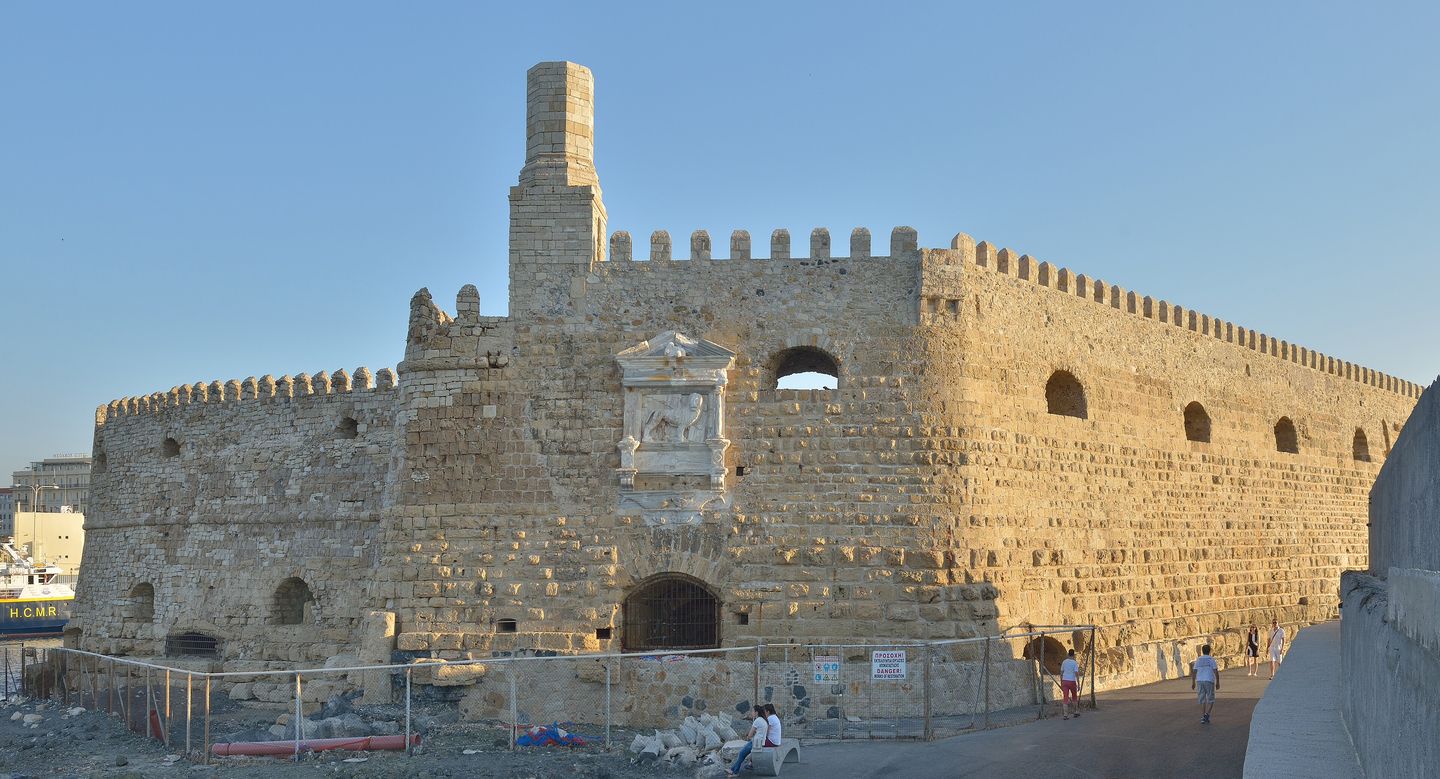
Beyond the Bronze Age, Heraklion carries its Venetian occupation (1211 to 1669) more visibly than almost any other Greek city: the Koules fortress still guards the harbour mouth, four and a half kilometres of bastioned walls still ring the old town, and the lion-headed Morosini Fountain still anchors the main square. Add a market street that has sold food on the same stones since the Ottoman period, a university city's bars and bookshops layered on top of all of it, and a ferry and flight network that makes the rest of Crete — Rethymno, the Lassithi Plateau, the south coast beaches — a day trip away, and the case for staying rather than passing through gets considerably stronger.
The calendarWhen to go
April, May, and early June are the best window: the countryside is green and wildflowering, the archaeological sites are bearable before the heat and the cruise-ship crowds both peak, and sea temperatures are warming without summer's crush. Late September through October is the other sweet spot — the sea is at its warmest of the year from swimming in all summer, the light softens, and the first autumn rains haven't yet arrived.
July and August bring serious heat, routinely into the mid-thirties Celsius and uncomfortable for walking Knossos or the old town's shadeless squares at midday, plus the heaviest cruise-ship traffic through the port, which can mean several thousand extra day-trippers converging on the same handful of sites between about 10am and 2pm. If you're travelling in summer, flip your schedule: ruins and museum in the early morning, the beach or a shaded taverna through the worst of the afternoon heat, the old town and harbourfront in the evening once it cools. Winter is quiet, mild by northern European standards, and the one season you'll have Knossos nearly to yourself, though some smaller sites and rural tavernas reduce hours or close.
LogisticsGetting around
Heraklion's old town is compact and walkable — the distance from the harbour fortress to the Archaeological Museum is well under a kilometre, and most of what matters sits inside or just outside the Venetian walls. Traffic within those walls is genuinely heavy and the driving can feel chaotic to visitors; park once at your accommodation and walk, rather than trying to drive between sights in the centre.
For Knossos, five kilometres south of the centre, city bus line 2 runs frequently from the Bus Station A near the port and from a stop close to the main square, and is by far the easiest option if you don't want a rental car. A taxi is a reasonable backup and inexpensive for the distance. If you're planning day trips further afield — the Lassithi Plateau, Matala, the south coast — a rental car is worth it for a day or two even if you otherwise stay car-free in the city, since Crete's intercity bus network (KTEL) is reliable on the main routes but thin on the smaller detours that make those trips worthwhile. Heraklion's airport sits right on the eastern edge of the city, a notably short and cheap taxi ride from the centre.
The tableHow Heraklion actually eats
Skip the harbourfront restaurants with laminated multilingual menus and the hawkers outside them — they are priced for cruise passengers and cook accordingly. The real eating happens a few streets back, particularly around the Lion Square side streets and along Odos 1866, the city's market street, where you can watch a kitchen's ingredients arrive before you order them. Cretan cooking is its own distinct regional cuisine within Greece, built on wild greens (horta), snails, the island's own dakos — barley rusk topped with tomato, crumbled mizithra cheese, and olive oil — and a wine and spirit culture built around raki, the grape-pomace spirit that arrives, unbilled, at the end of almost every meal as a gesture of hospitality rather than a product to order.
Lunch is the easiest meal to get right: look for a taverna with a handwritten daily menu and no photos, order whatever the wild greens dish is that day, and don't be surprised if the owner steers you toward something not on the menu at all. Dinner runs properly late, rarely getting going before 8:30pm. Odos 1866 itself is worth a visit even if you're not buying anything — cheese, honey, dried herbs, snails in buckets, and fish stalls selling the morning's catch, all within a single pedestrian lane that has functioned as the city's larder for well over a century.
The mapNeighbourhoods to know
The old town inside the Venetian walls is where you want to be based. Around Lion Square (Plateia Venizelou) and its Morosini Fountain is the liveliest and most central patch, dense with cafés, shops, and the market street a minute's walk away — busy, a little touristy right on the square itself, but the obvious base for a short stay. The harbour district around the Koules fortress trades some of that energy for sea views and the best sunset spot in the city, with the old Venetian arsenali (shipyards) along the eastern breakwater worth a detour.
South and east of the centre, near the Archaeological Museum and the Historical Museum of Crete, the streets are quieter and more residential, a good choice if you want proximity to both museums without the square's noise. Heraklion is also a genuine university city — there's a sizeable student population that gives certain streets, especially toward the eastern edge of the old town, a bar and café scene with more locals than visitors in it, worth seeking out for an evening that doesn't feel staged for tourists.
Field intelligencePractical intelligence
Buy your Knossos ticket online in advance, and consider the combined ticket that covers both Knossos and the Archaeological Museum — it's better value and encourages you to do both, which you should: the museum gives context the ruins alone don't provide. Go to Knossos at opening, not midday; the site has very little shade and the cruise-ship coach groups arrive in force from mid-morning.
Heraklion airport (HER) sits close enough to the centre that a taxi rarely takes more than fifteen to twenty minutes outside peak traffic. ATMs and card payment are standard everywhere in the centre, though smaller rural tavernas on day trips may be cash-only. Sun protection matters more here than the temperature alone suggests — Crete's light is intense and shade is scarce at most archaeological sites. And set expectations correctly about reconstruction: Knossos includes concrete restoration work from Sir Arthur Evans's early-20th-century excavation that is now controversial among archaeologists for how much it reflects his interpretation rather than confirmed fact — worth knowing before you go so the bright red columns don't surprise you.
What to see & do
-
Knossos Palace
The largest Bronze Age archaeological site on Crete and the legendary seat of King Minos, excavated from 1900 by Sir Arthur Evans, who named the civilisation he uncovered 'Minoan' after the myth.
Tip:Arrive at opening and bring your own water and shade — there is almost none on site, and midday heat with coach-group crowds is the worst possible combination.
-
Heraklion Archaeological Museum
The single best collection of Minoan art and artefacts anywhere, including the Phaistos Disc, the bull-leaper fresco, and faience reliefs that make sense of what Knossos's bare stone cannot show you.
Tip:Visit before or after Knossos, not instead of it — the two sites complete each other, and a combined ticket covers both.
-
Koules Fortress (Rocca a Mare)
The squat Venetian sea fortress guarding the mouth of the old harbour, built in the early 16th century and still the city's defining silhouette from the water.
Tip:Climb to the rooftop for the best sunset view in Heraklion, looking back over the harbour toward the old town.
-
Venetian Walls & Martinengo Bastion
Four and a half kilometres of 16th-century fortification encircling the old town, among the most intact Venetian defensive works surviving anywhere — the Martinengo Bastion also holds the grave of Cretan author Nikos Kazantzakis.
Tip:Walk the Martinengo stretch in the early evening for wide views over the city and, on a clear day, Mount Ida in the distance.
-
Odos 1866 (the market street)
A single pedestrian lane that still functions as the city's working market — cheese, herbs, honey, snails, and the morning's fish catch sold the way it has been for generations.
Tip:Go mid-morning for the fullest stalls, and don't be shy about asking a vendor what to do with an ingredient you don't recognise.
-
Lion Square & the Morosini Fountain
The social heart of the old town, named for the four lions carved into its 17th-century Venetian fountain, ringed by cafés that double as the city's living room from morning coffee to late-night drinks.
Tip:Order a frappé or a Greek coffee and simply sit — the square is better watched than photographed.
-
Historical Museum of Crete
The story the Archaeological Museum doesn't tell — Byzantine, Venetian, Ottoman, and 20th-century Crete, including the island's role in the Battle of Crete and the only Nikos Kazantzakis room on the island.
Tip:Underrated and usually uncrowded; budget an hour and pair it with the nearby harbourfront for an easy afternoon.
-
Agios Titos Church
A church that has been Byzantine, then an Ottoman mosque, then Orthodox again, holding what is venerated as the skull relic of Saint Titus, Crete's patron saint and a companion of the Apostle Paul.
Tip:It's a short detour off the market street and free to enter — worth five minutes even for the non-religious, for the layered architecture alone.
-
CretAquarium
A large Mediterranean aquarium housed in a former US Air Force base east of the city at Gournes, built around tanks that previously supported marine research rather than an entertainment venue.
Tip:A strong rainy-day or with-kids option; it's a short bus or taxi ride east of the centre, not walkable from the old town.
On the groundWhere things are
Map data © OpenStreetMap contributors.
Where to stayBase yourself well
Around Lion Square
Best for first-timers who want everything on footThe liveliest, most central patch of the old town — cafés, shops and the market street all within a few minutes' walk, with a buzz that runs from morning coffee to late evening.
A small boutique hotel just off Lion Square
Look for a converted townhouse a street or two back from the square itself — the location without the fountain-side noise at night.
€€A central apartment near the market street
Staying a short walk from Odos 1866 means fresh produce and a real neighbourhood feel on your doorstep.
€€The old harbour
Best for sea views and sunset walksSea views, the Koules fortress on your evening walk, and the best sunset spot in the city — a short stroll rather than a sprint from the main sights, with a slightly calmer pace than the square.
A waterfront hotel facing the fortress
Rooms facing the harbour let you watch the fishing boats and the fortress light up at dusk without leaving the building.
€€€Near the Archaeological Museum
Best for museum-focused stays and a quieter night's sleepQuieter, more residential streets south and east of the main square, close to both major museums and a short walk from the bus to Knossos.
A mid-range hotel near Eleftherias Square
A calmer base that still puts the museum, the bus to Knossos, and the old town centre all within ten minutes on foot.
€€Ammoudara beach strip
Best for travellers who want a beach alongside the city sightseeingA beach-resort stretch a few kilometres west of the centre, with sand, sea swimming, and larger hotels — a trade of old-town atmosphere for direct beach access.
A beachfront hotel at Ammoudara
Good if you want to swim daily and treat the old town as a short bus or taxi trip rather than your base.
€€€Affiliate notePostcardRoute is reader-supported. Some links to Booking.com (stays, flights, car hire, tickets and tours, airport transfers) are affiliate links, tracked through CJ Affiliate: if you book through them we may earn a small commission at no extra cost to you. We only recommend places we would send a friend.
Book the restEverything else for the trip
Stay sorted? These open Booking.com for the other legs of the journey.
-
Tours & tickets
Things to do in Heraklion
Skip-the-line tickets, tours and day trips.
Browse activities -
Wheels
Car hire in Heraklion
Compare pick-up points and rental companies.
Compare cars -
Air
Flights
Search fares, then come back for the neighbourhood advice.
Search flights -
Ground
Airport transfers
Book a taxi or private transfer before you land.
Book a transfer
Affiliate noteThese four links are affiliate links too: if you book through them we may earn a small commission at no extra cost to you.
Beyond the cityWorthwhile day trips
- Phaistos & the Messara Plain
A second major Minoan palace complex, less visited and less reconstructed than Knossos, with a genuinely spectacular hilltop setting over Crete's fertile southern plain — about an hour's drive south.
- Lassithi Plateau
A high mountain plain once studded with thousands of white-sailed windmills, ringed by villages and the Diktaean Cave, mythical birthplace of Zeus — a scenic full-day drive southeast.
- Matala & the south coast
A former 1960s hippie hideaway built around Roman-carved cliff caves and a genuinely excellent beach, roughly an hour and a half south — pair it with Phaistos on the way if you have the time.
- Rethymno
Crete's prettiest Venetian harbour town, about an hour west by car or KTEL bus, with a fortress, a labyrinthine old town, and a far gentler, more photogenic pace than Heraklion's working-city energy.
Before you goCommon questions
- How many days do you need in Heraklion?
- A day and a half covers the essentials properly — Knossos and the Archaeological Museum need the better part of a day between them, with an evening and a morning left for the old town, the market street, and the harbour. Add extra days if you're using the city as a base for day trips across central and eastern Crete.
- Is Knossos worth visiting without a guide?
- It's possible, but the ruins alone are hard to read without context — a guided tour, an audio guide, or at minimum visiting the Archaeological Museum either before or after will make far more sense of what you're looking at than the bare stone and reconstructed columns on their own.
- What's the best time of day to visit Knossos?
- As close to opening as you can manage. The site has very little natural shade, Crete's summer heat builds quickly, and cruise-ship coach groups converge from roughly mid-morning onward — an early visit avoids both problems at once.
- Is Heraklion or Chania a better base for Crete?
- Heraklion wins on access to Knossos, the best museum on the island, and central-island day trips; Chania wins on old-town charm and a prettier harbour. Many visitors split a trip between the two rather than choosing — they're roughly an hour and a half apart by road.
- Do I need a rental car in Heraklion?
- Not for the city itself — the old town is walkable and buses reach Knossos easily. You will want one, even just for a day or two, to reach places like the Lassithi Plateau or Matala, where Crete's bus network thins out considerably.
- What is raki and will I be served it without asking?
- Raki is a strong, clear grape-pomace spirit distilled across Crete, and yes — it's common for a taverna to bring a small complimentary glass at the end of a meal as a gesture of hospitality, not an upsell. It's polite to accept at least a sip even if you don't finish it.
- Is Heraklion safe and easy to navigate?
- Yes to both. It's a large, functioning Greek city with normal urban-safety precautions rather than any particular risk, and the old town's compact grid inside the Venetian walls is easy to navigate on foot once you orient yourself around Lion Square and the harbour.