
Greece · Ionian Islands
Corfu, the Greek island that never quite stopped being Venetian
Four centuries of Venetian rule, fifty years of British administration, and a landscape too green for the postcard idea of Greece — Corfu is the Ionian island that argues with itself in the best way.
A Venetian old town, a British cricket pitch, and the greenest coastline in Greece · 39.62° N · 19.92° E
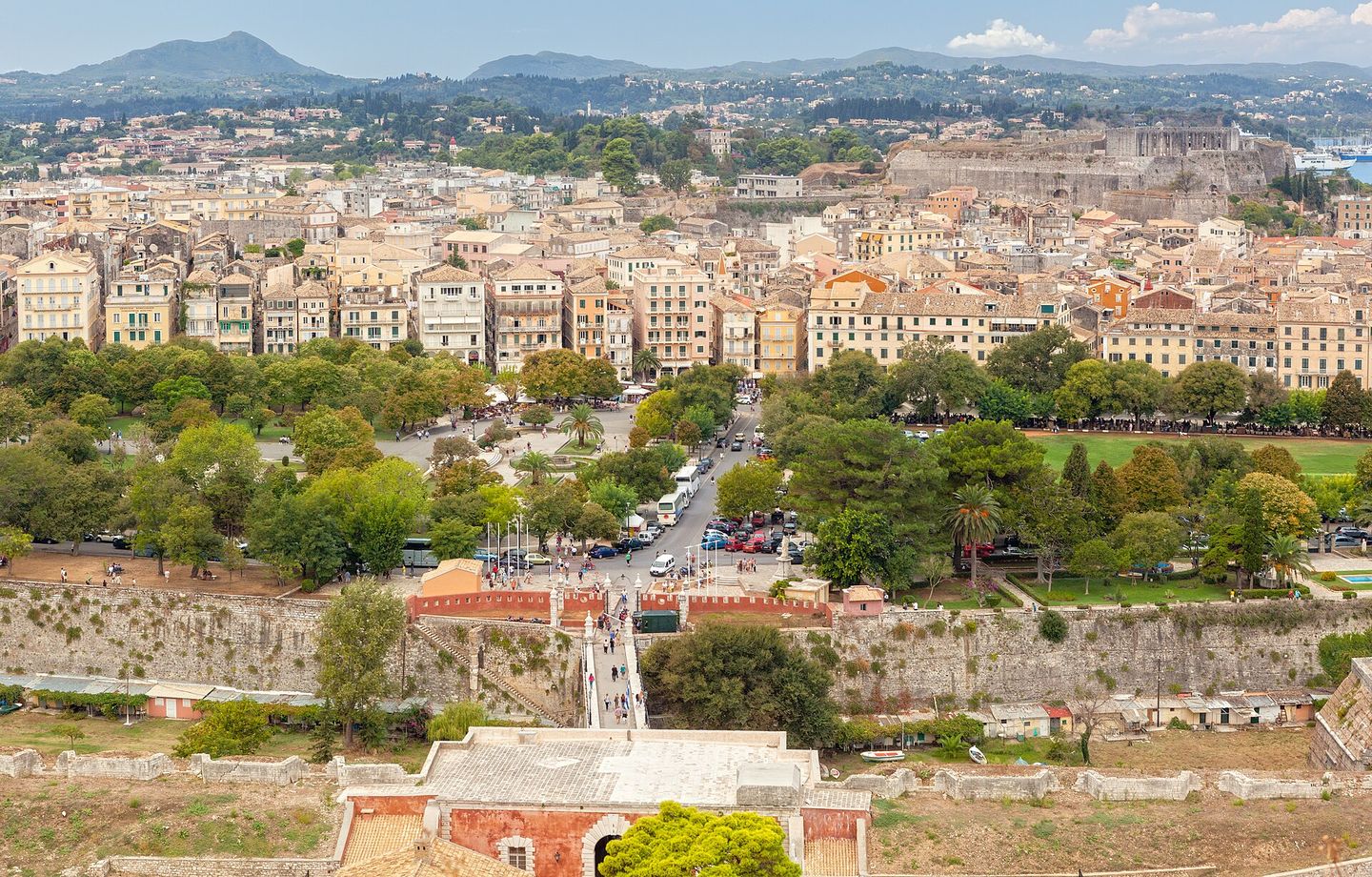
Most people arrive in Corfu expecting whitewashed cubes and blue shutters, the standard-issue Greek island look sold by every brochure since the 1970s. They get something else entirely: a Venetian town of ochre and pistachio-coloured townhouses, a French-built arcade facing a cricket pitch, and a coastline so densely forested with olive and cypress that early travellers called it the greenest island in the Mediterranean. Corfu spent four hundred years as a Venetian possession, a few decades under French and Russian control, and half a century as a British protectorate before it ever became properly Greek, and the island still carries all of that in its architecture, its vocabulary, and, oddly, in its taste for ginger beer and cricket.
The island's modern reputation runs in two directions that barely overlap. One is the Old Town of Corfu, a UNESCO World Heritage Site dense enough with Venetian, French and British layers to reward several unhurried days, built around a natural harbour between two fortresses. The other is the resort coast — package-holiday strips on the north and east shores that built Corfu's reputation among British and Italian sunseekers from the 1960s onward, and that most travel writing either ignores or leans into entirely. Neither version is the whole island. The old town deserves the time most itineraries don't give it, and the coast, away from the three or four most built-up strips, still delivers the pine-backed coves and turquoise water that made Corfu famous before package tourism arrived.
What follows treats Corfu as a place with a real centre of gravity rather than a beach with a town attached. That means spending real time in Kerkyra, as the old town is formally known, understanding why the island feels more Adriatic than Aegean, and being honest about which beaches are worth a rental car and a long drive and which are worth skipping entirely.
The caseWhy Corfu earns the detour
Corfu is the rare Greek island where the main town is as strong a reason to visit as the coastline. The Old Town survived the twentieth century almost entirely intact — it dodged the kind of concrete overbuilding that hollowed out so many other Greek harbour towns, partly because UNESCO recognition came relatively early to local preservation debates, and partly because the Venetians who laid it out built for density rather than sprawl. The result is a genuine walking city: covered alleys called kantounia, Venetian campaniles, a French-built promenade facing a British-built cricket ground, all compressed onto a narrow peninsula between two fortresses.
The island's layered history is not a museum footnote, it's legible everywhere you look. Street signs still occasionally carry Italian-inflected names, church interiors hold Byzantine and Catholic iconography side by side (a legacy of Venetian Catholic rule over a Greek Orthodox population), and the Liston arcade was modelled directly on the Rue de Rivoli by French engineers during Corfu's brief stint as capital of the Napoleonic Ionian Republic. Add a genuinely dramatic landscape — limestone cliffs, dense olive groves planted by the Venetians themselves as a cash crop, and a west coast that produces some of the most photographed coves in the Mediterranean — and Corfu has a claim to being the most historically layered island in Greece, not simply the greenest.
The calendarWhen to go
Late May through June, and again mid-September through early October, are the honest sweet spots. The sea has warmed enough to swim properly, the light is clear, and the worst of the July-August coach traffic and resort crowding hasn't arrived or has already thinned out. Hotel rates in these shoulder windows typically run well below peak summer, and the Old Town's alleys are walkable without the cruise-ship crush that hits certain mornings in high season.
July and August are Corfu at full capacity — hot, busy, and priced accordingly, with the resort strips at Kavos, Sidari and parts of the east coast operating at a different register entirely from the old town. If beach-club nightlife is the point, this is still the right window. If it isn't, avoid it. Easter is a genuine exception worth planning around on its own terms: Corfu's Orthodox Easter celebrations, especially the pot-throwing ritual on Holy Saturday and the island's distinctive philharmonic marching bands, are among the most singular religious festivals in Greece, and hotel beds disappear months ahead. Winter sees the island largely shut down outside Corfu Town itself — many coastal hotels and restaurants close completely from November to April.
LogisticsGetting around
Corfu Town itself is entirely walkable and largely pedestrianised at its core — do not rent a car for the old town, there is nowhere sane to park and the kantounia alleys are often too narrow for anything wider than a moped. For the rest of the island, a rental car is close to essential. Corfu is roughly 60 kilometres end to end and the public bus network (green buses for town routes, blue KTEL buses for the island-wide network) runs infrequently enough that it suits day-trippers with patience rather than travellers trying to cover ground efficiently.
Ferries connect Corfu Town's new port to Igoumenitsa on the mainland in about ninety minutes, and to Italian ports — Brindisi, Bari, Ancona — on longer overnight or multi-hour crossings that make Corfu a genuinely workable stop on an Italy-Greece overland route rather than a flight-only island. Corfu International Airport (CFU) sits unusually close to town, a notoriously tight approach over the lagoon that pilots and plane-spotters both talk about. Taxis from the airport into town run a fixed short hop; renting from the airport itself is straightforward and the better move if beaches and villages beyond the capital are on the itinerary, which they should be.
The tableHow Corfiots actually eat
Corfiot food is distinct from mainland Greek cooking in ways that reward seeking out the local dishes rather than defaulting to souvlaki. Four centuries of Venetian rule left a genuine culinary fingerprint: sofrito (veal slow-cooked in white wine, garlic and vinegar), pastitsada (a rich tomato-and-spice beef or rooster stew served over thick pasta, the island's signature Sunday dish), and bourdeto (a fiery, paprika-red fish stew, traditionally made with scorpionfish) all trace directly back to Venetian-Corfiot cross-pollination rather than mainland tradition.
The British left a stranger, more specific legacy: tsitsibira, a mildly alcoholic ginger beer still brewed and sold on the island, and a genuine local taste for cricket-adjacent snacking that has nothing to do with contemporary Greek cuisine elsewhere. Kumquats, improbably, are the other British-adjacent crop that stuck — introduced to Corfu in the 19th century, they're now distilled into a bright orange liqueur sold everywhere as a souvenir, and candied kumquat is a genuine local sweet worth trying once. For the everyday meal, look for tavernas specifically advertising Corfiot cuisine rather than generic Greek tourist menus; the difference in what lands on the table is substantial, and prices for the real dishes are not noticeably higher.
The mapNeighbourhoods and areas to know
Campiello, the oldest residential quarter of the Old Town, is a genuine maze of Venetian townhouses, hidden squares and washing lines strung between balconies — it photographs beautifully and still functions as a lived-in neighbourhood rather than a museum piece. The Liston and Spianada form the town's civic heart: a vast open square, one of the largest in the Balkans, flanked by the French-built arcaded promenade where Corfiots still take their evening volta, or stroll, exactly as they have for two centuries.
Garitsa Bay, just south of the old town past the Old Fortress, is a quieter residential waterfront with a long seafront promenade and views back toward the fortress walls — a good base for travellers who want old-town proximity without sleeping inside the tourist core. Kanoni, further south again, is where most travellers come specifically for the view over Vlacherna Monastery and Mouse Island rather than to stay, though a handful of hotels do cling to the peninsula. Beyond the capital, the island splits roughly into a built-up, package-tourism east and north coast (Kavos, Sidari, Dassia) and a more dramatic, less saturated west coast running from Paleokastritsa down to Agios Gordios, where the real cliff-and-cove scenery lives.
Field intelligencePractical intelligence
Corfu drives on the right, unlike the UK whose influence otherwise lingers everywhere else — rental cars are standard manual or automatic Continental-spec vehicles, not right-hand-drive. The island's mountain and coastal roads, especially toward Paleokastritsa and the north, are narrower and more switchback-heavy than they look on a map; budget more driving time than the distance suggests, particularly in summer traffic.
Much of the Old Town's finest architecture sits inside a genuinely active earthquake zone — the Ionian Islands are seismically among the most active parts of Greece, which is part of why Corfu's old buildings were constructed with a particular Venetian masonry style built to flex rather than stand rigid. It's not a practical concern for a short visit, but it explains some of the architectural quirks if you notice them. Tap water in Corfu Town is generally safe but mineral-heavy; bottled water is cheap and widely preferred locally. And carry cash for smaller tavernas and beach bars outside the capital — card acceptance drops off quickly once you're off the main tourist streets.
What to see & do
-
Old Fortress (Palaio Frourio)
The Venetian citadel that gives the Old Town its defining silhouette, built on a rocky promontory separating the town from Garitsa Bay, with sweeping views back over the rooftops and out to the mainland.
Tip:Climb to the lighthouse at the summit in the late afternoon for the best light over both bays at once.
See full guide -
The Liston & Spianada Square
A French-built arcaded promenade facing one of the largest open squares in the Balkans, still used for the evening volta and, in a very un-Greek twist, an actual cricket pitch maintained since British rule.
Tip:Take a coffee at one of the Liston cafés around sunset, when the arcade's lamps come on and the square fills with locals rather than tour groups.
-
Achilleion Palace
A neoclassical palace built in the 1890s for Empress Elisabeth of Austria (Sisi), dense with Achilles-themed statuary and gardens, and later a filming location for a James Bond casino scene.
Tip:Go for the terrace gardens and the view over Gastouri village as much as the interior — the statuary collection outside is the real draw.
-
Paleokastritsa
A series of turquoise coves folded into dramatic cliffs on the west coast, widely considered the island's most photogenic stretch of water and the base for boat trips into sea caves nearby.
Tip:Arrive before 10am in high season — by midday the car park fills and the coves get genuinely crowded.
-
Angelokastro
A ruined Byzantine hilltop fortress above Paleokastritsa that never fell to the Ottomans, with a punishing climb rewarded by one of the best panoramic views on the island.
Tip:Pair it with Paleokastritsa in the same morning — the two sit a short drive apart and the fortress is far cooler to climb before midday heat sets in.
-
Kanoni & Mouse Island
The classic postcard view: Vlacherna Monastery on its own tiny causeway-linked islet, with Pontikonisi (Mouse Island) and its cypress trees floating just beyond in the lagoon.
Tip:The view is better from the Kanoni viewpoint itself than from a boat — save the short boat trip to Pontikonisi for if you actually want to land on the island.
-
Pelekas
A hill village on the west coast famous for the Kaiser's Throne viewpoint, originally a favourite sunset spot of Kaiser Wilhelm II, looking down over the coastline on both sides of the island.
Tip:Time the drive up for an hour before sunset; the viewpoint gets a real crowd for the final ten minutes of golden light.
-
Corfu Museum of Asian Art
Housed in the old British Palace of St Michael and St George on the Spianada, an unexpectedly deep collection of Chinese, Japanese and Indian art assembled by 20th-century Greek diplomats and collectors.
Tip:The building's own terrace garden, overlooking the bay, is worth the ticket on its own even on a day you're not in the mood for the galleries.
On the groundWhere things are
Map data © OpenStreetMap contributors.
Where to stayBase yourself well
The Old Town (Campiello)
Best for first-timers and history-focused travellersStaying inside the Venetian core means waking up inside the UNESCO site itself — narrow kantounia alleys, washing lines overhead, and everything walkable. No cars reach most doorsteps, so pack light.
A restored townhouse near Campiello
Look for a boutique conversion of an old Venetian building rather than a modern block — the old town's charm is largely architectural.
€€€A small hotel just off the Liston
Puts the Spianada and the evening volta on your doorstep, at the cost of some street noise from the café terraces below.
€€Garitsa Bay
Best for travellers who want quiet evenings within walking distance of everythingA quieter residential waterfront just south of the Old Fortress, with a long seafront promenade and old-town proximity without sleeping inside the tourist core.
A seafront hotel on the Garitsa promenade
A ten-minute walk gets you into the old town, and the bay views at breakfast are hard to beat for the price.
€€Paleokastritsa & the west coast
Best for beach-focused stays and boat excursionsDramatic cliffs, turquoise coves and the island's most photographed coastline — further from town, but the right base for travellers prioritising beaches and boat trips over old-town wandering.
A clifftop hotel above Paleokastritsa bay
Pay a little more for a sea-facing room; the coves below are worth waking up to directly rather than driving in each morning.
€€€Agios Gordios & the south-west coast
Best for beach days with a calmer, less corporate resort feelLong sandy beach backed by dramatic hills, with a more laid-back, less built-up energy than the north-coast resort strips, popular with a younger backpacker-leaning crowd as well as families.
A beachfront hotel directly on Agios Gordios sands
The beach itself is the whole point here; keep the room simple and spend the budget on the view.
€€Dassia & the north-east coast
Best for families and all-inclusive beach staysThe island's established package-holiday belt — calm, shallow water, olive-grove backdrops, and the highest concentration of all-inclusive resorts, well suited to families wanting a straightforward beach base.
A family resort on the Dassia waterfront
Shallow, calm water here suits small children better than the more exposed west-coast coves.
€€€Affiliate notePostcardRoute is reader-supported. Some links to Booking.com (stays, flights, car hire, tickets and tours, airport transfers) are affiliate links, tracked through CJ Affiliate: if you book through them we may earn a small commission at no extra cost to you. We only recommend places we would send a friend.
Book the restEverything else for the trip
Stay sorted? These open Booking.com for the other legs of the journey.
-
Tours & tickets
Things to do in Corfu
Skip-the-line tickets, tours and day trips.
Browse activities -
Wheels
Car hire in Corfu
Compare pick-up points and rental companies.
Compare cars -
Air
Flights
Search fares, then come back for the neighbourhood advice.
Search flights -
Ground
Airport transfers
Book a taxi or private transfer before you land.
Book a transfer
Affiliate noteThese four links are affiliate links too: if you book through them we may earn a small commission at no extra cost to you.
Beyond the cityWorthwhile day trips
- Paxos & Antipaxos
A smaller, car-free island an hour or so south by ferry or speedboat, with some of the clearest water in the Ionian and a far quieter pace than Corfu's main resort coast.
- Saranda & Butrint, Albania
A short ferry crossing to the Albanian Riviera, with the UNESCO-listed Greco-Roman ruins at Butrint a short drive beyond the port — a genuinely different country and a different pace of history in a single day.
- The Diapontia Islands
A cluster of tiny, little-visited islets off Corfu's north-west tip — Othonoi, Ereikoussa and Mathraki — reachable by seasonal ferry and rewarding anyone who wants to see what Corfu looked like before tourism arrived.
Before you goCommon questions
- How many days do you need in Corfu?
- Five to seven days lets you properly split time between the Old Town and the coast, with at least one day trip. Three days is workable if you focus on the town and one west-coast beach area and accept you won't see the full island.
- Is Corfu Town worth visiting, or is it just a beach island?
- The Old Town is a UNESCO World Heritage Site and arguably the single best reason to visit Corfu specifically rather than any other Greek island — the Venetian, French and British layers are genuinely dense and well preserved, and most visitors underrate how much time it deserves.
- Do you need a car in Corfu?
- For the Old Town, no — it's walkable and effectively car-free at its core. For everything else — Paleokastritsa, Angelokastro, the west-coast beaches, Pelekas — a rental car is close to essential, since the bus network is infrequent and taxis for full-day touring add up quickly.
- What is the best time of year to visit Corfu?
- Late May to June and mid-September to early October are the sweet spots — warm enough to swim, clear light, and noticeably fewer crowds and lower prices than the July-August peak.
- Why does Corfu feel different from other Greek islands?
- Corfu was never under direct Ottoman rule — it was a Venetian possession for roughly four centuries, then briefly French and Russian, then a British protectorate until 1864. That history shows up in the architecture, the cricket pitch on the Spianada, the Venetian-Corfiot dishes like pastitsada and sofrito, and even in local ginger beer, none of which have mainland Greek equivalents.
- Which Corfu beach is actually worth the drive?
- Paleokastritsa earns its reputation — the cliffs and cove colour are genuinely exceptional, especially paired with the Angelokastro climb nearby. Agios Gordios on the south-west coast is the better pick for a calmer, less corporate resort beach without sacrificing scenery.